I have finally given up and installed firefox again. I was a little disapointed that the ‘Live bookmarks’ feature was not as good at displaying news feeds as Internet Explorer, however I quickly rectified this situation by Installing Sage
Lake District Holiday
I recently went on holiday to the Lake District with my girlfriend Johanna, Our Australian friends Micheal and Melissa, Johanna’s sister Trish and her boyfriend Chris. We arrived in Backbarrow on Thursday afternoon unpacked, settled in, and had a really nice steak dinner that Mike cooked for us. On Friday we went for a boat trip on Lake Windermere. The boat took us from Lakeside to Browness. We walked around Browness village before having lunch in a local pub. We caught the boat back to Lakeside in the afternoon, and visited an aquarium in Lakeside. On Saturday we had to get up really early as we had booked an assault course activity day in Grizedale, it was quite an exhilarating experience. On Sunday, we packed our bags and said goodbye to the cottage in Backbarrow, and headed towards Ingleton. In Ingleton we went for a 5 mile Waterfall Trail walk, It was really nice to get some fresh air and strech our legs.
Mplayer on Tom Tom
I am now trying to run Mplayer on Tom Tom so that I can watch videos and drive anyone reading this to drink. I found however that Mplayer requires a lot of system resources that are being used by the Navigation application (ttn) So I needed a way to free up the memory and resources being used by the application. This should be as simple as just killing the application using
killall ttn
But the problem is that the ttn application is responsible for petting the dog. That is to say that there is a WatchDog Timer which resets the device after 15 seconds unless something continuously resets the timer.
All that was needed was a script to reset the timer instead, So here is my solution:
#!/bin/sh
killall ttn &&
while(true) do
echo '' > /dev/watchdog
sleep 10
done
The trick is to kill the ttn but also keep the Watchdog from reseting the device. The script also has to be invoked as a background job, so I used an ‘&’ after the command.
./free.sh &
Linux on Tom Tom

I recently discovered how Hacker Friendly My Tom Tom is. Here is a screenshot of TomTom running a text console with on screen keyboard.
Hold on to my Tom Tom, Tom
 My TomTom arrived in the post today. I was very excited but managed to hold of my temptation to open the box until I had at least had my dinner. Later on I wanted to try it out whilst taking my friend Tom to the local Morrisons, I handed it to him and said “Hold on to my Tom Tom, Tom”. Ha Ha Ha I am so funny. The TomTom was a Christmas present (well actually I bought it in the Halfords sale using money my parents gave me for christmas). I am very pleased with it so far, its very easy to use and very intuative. In fact I didn’t need to reference the manual at all… not that I ever do anyway.
Bass Amplifier Module
 My amplifier in my 12″ wharfedale subwoofer is playing up, but I have found an active subwoofer power amplifier that is suitable for compact hi-fi and home cinema subwoofer cabinets, which I am hoping I can use as a suitable replacement.
Reason 4.0
My long awaited free Upgrade to Propellerheads Reason 4.0 has finally arrived. Propellerheads seem to have been quite smart in thier way of delivering upgrades, rather than distributing two versions of thier product they simply distribute the full version only. The upgrade verification is done by registering your old version online and entering an upgrade code at which point they will email you the full version product key.
Barclays PinSentry
 My PinSentry device from Barclays arrived today. I really think its a good move by Barclays to introduce this two-factor authentication. The only trouble with this type of security is that it doesn’t protect against man in the middle attacks, so its still important to check that the site you are visiting has the https:// in the address bar.
Christmas Eve at the office.
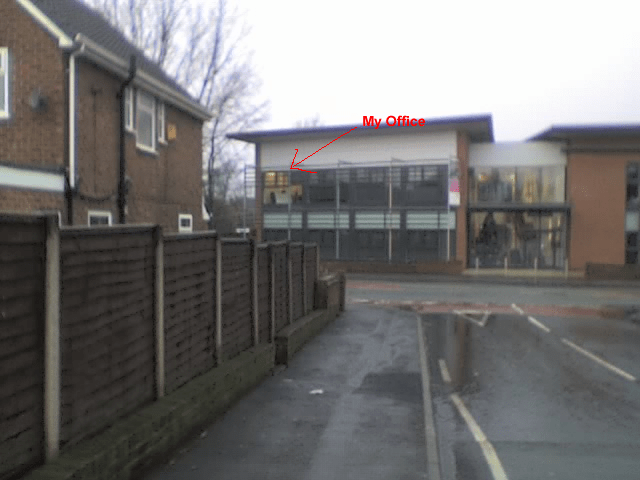
Look I am the only one here 😦
Tricubic interpolation
I have been thinking a lot about how to convert between various frame rates. Basic frame rate conversion works by dropping or duplicating frames. For example converting 30fps material to 25fps material will drop one frame in every six. More advanced techniques such as those employed by Motion Perfect or MSU AFRC are able to create new frames based on the existing frames that exist. These frames are more than a simple blend of the existing frames and use motion detection algorithms to resolve an intermediate frame from two source frames.
The approach that I would like to try is to use tricubic interpolation this is similar to the well known bicubic interpolation that is used to scale images in two dimensions. Tricubic interpolation operates in three dimensions x y and t. While there exists a library for calculating interpolated points in three dimensions, I have no clue how to use the library for my purposes because I do not yet fully understand how to compute the numerical derivatives.
 Giles Bathgate